A focused coalition of academia, industry, and nonprofits unites to advance STEM education from elementary school to postdoctoral study
Rochester, NY — 6 May 2026 — The Army STEM Education Consortium (ASEC) has been awarded a 10-year cooperative agreement by the U.S. Department of the Army Science, Technology, Engineering, and Mathematics (Army STEM) to deliver a comprehensive portfolio of STEM education and workforce development programs serving students and educators across the United States.
ASEC brings together a diverse coalition of organizations — spanning academia, for-profit, nonprofit, and government sectors — each contributing unique capabilities to a unified mission: expanding STEM pathways and building a future-ready workforce prepared for the demands of rapid technological change and national security priorities.
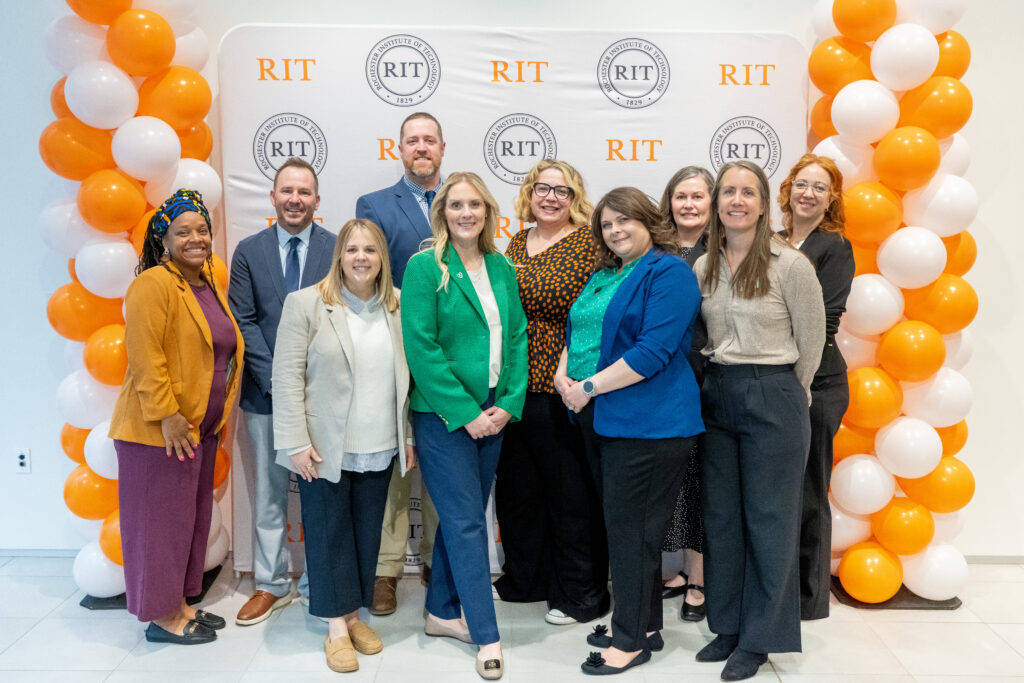
Leaders of the Army STEM Education Consortium gathered to celebrate the official announcement of the 10-year contract to expand STEM pathways and support Army readiness. Tuesday, May 5, 2026, at Rochester Institute of Technology.
ASEC’s programming spans STEM enrichment experiences, competitions, internships, and teacher professional development, creating long-term pathways into STEM education and careers for students from elementary school through postdoctoral study. A defining priority of the consortium is building a connected STEM ecosystem — one where students who engage early with Army STEM programs can grow into mentors, educators, researchers, and professionals within a national community of practice.
The consortium’s collaborative model reflects a shared conviction that STEM education must keep pace with a rapidly changing world.
“The future of STEM education and workforce development is rapidly evolving,” said Donna Burnette, Executive Director of RIT’s K-12 University Center and ASEC Chair and Principal Investigator. “To remain effective and impactful, Army STEM must be flexible, adaptive, and innovative — and anticipate the needs of the future workforce and the mission it supports. Together, we have assembled a remarkable group of organizations, each bringing deep expertise, unique capabilities, and a shared commitment to preparing the next generation of scientists, engineers, and innovators who will contribute to the Army’s mission.”
The cooperative agreement is administered by the U.S. Army Combat Capabilities Development Command (DEVCOM) on behalf of the Assistant Secretary of the Army for Acquisition, Logistics, and Technology (ASA ALT).
Army STEM program leadership underscored the strategic significance of the 10-year investment. “The Army STEM Education Consortium is a vital investment in our nation’s scientific and innovative future,” said Brian Leftridge, STEM Program Manager and ASEC Cooperative Agreement Manager for U.S. Army DEVCOM. “By cultivating a diverse STEM talent pipeline from early education through postgraduate research, ASEC builds the expert workforce required for tomorrow’s research and development. This sustainable talent pool equips the Army and the nation to master emerging technologies and solve the world’s most complex technical challenges.”
───
The Army STEM Education Consortium: Leading the Charge
A core group of organizations leads the strategy, design, and delivery of AEOP programs. Together, they shape the vision, make key decisions, and ensure high-quality experiences for students nationwide.
Rochester Institute of Technology serves as the lead organization for the Army STEM Education Consortium (ASEC), guiding the vision, strategy, and execution of this coordinated, nationwide portfolio of STEM programs. One of the largest private universities in the U.S., RIT has been a recognized educational leader since 1829, know for its role in training and launching creators, entrepreneurs, innovators, and researchers.
Building on its strengths in experiential learning, applied research, and cross-sector collaboration, RIT oversees consortium operations, fosters alignment across partners, and ensures programs are innovative, scalable, and impactful. Through this leadership, RIT is helping to create a connected STEM ecosystem—one that supports learners across multiple stages and prepares the next generation of scientists, engineers, and innovators to contribute to national security and technological advancement.
Blake Learning Solutions is a full-service training, communications, and technology firm specializing in large-scale workforce development and strategic outreach. With decades of experience supporting federal agencies—including the U.S. Army, Navy, Department of Homeland Security, and AEOP—BLS brings deep expertise in branding, digital platforms, and learning systems. As the consortium’s lead for strategic communications and marketing, BLS designs and implements an integrated outreach strategy, develops the Army STEM digital ecosystem, and ensures cohesive messaging that strengthens engagement across the full STEM pipeline.
Griffiss Institute is a 501(c)(3) not-for-profit organization based in Rome, NY, accelerating national security innovation through its three-pillar mission of Talent, Technology, and Venture Development. As the steward of the Innovare Advancement Center, an open, unclassified research and collaboration campus, Griffiss Institute fosters and drives partnerships across government, industry, and academia to advance dual-use technologies. Griffiss Institute is committed to strengthening national security through nontraditional STEM education, accelerated innovation, and the commercialization of emerging technologies, with a deep belief in American-made solutions, and the development of a resilient U.S. science and engineering workforce.
How Griffiss Institute Helps AEOP Reach Students
Griffiss Institute helps AEOP connect with organizations and programs through the Outreach Awards. They manage the process, share information, and make it easier for other groups to bring AEOP STEM programs to more students – especially those from military-connected communities at regional sites nationwide.
In short, GI helps AEOP reach more students by supporting the organizations that deliver AEOP programs.
ICF is a nationally recognized leader in data analytics, program evaluation, and evidence-based decision-making, with extensive experience supporting federal STEM and workforce initiatives. As the consortium’s lead for data management, analysis, and reporting, ICF will design and implement a comprehensive evaluation framework to measure program impact, inform strategic improvements, and ensure accountability across the portfolio. Building on its prior work with Army STEM—including development of the program’s first data dashboard—ICF will provide the analytical foundation needed to strengthen outcomes and guide long-term success.
The National Science Teaching Association is a leading professional organization representing more than 35,000 science educators and professionals committed to advancing high-quality STEM education nationwide. Through its work in professional learning, publications, national conferences, and student competitions—including flagship Army STEM programs like eCYBERMISSION, Gains in the Education of Math and Science (GEMS), and the Department of War’s Junior Science and Humanities Symposium—NSTA brings unparalleled reach and credibility in engaging educators and students. Within the consortium, NSTA supports program delivery, educator engagement, and the development of a strong, connected national STEM community.
Tennessee Technological University is a nationally recognized, STEM-focused institution known for delivering high-impact education, applied research, and workforce-ready graduates. Through initiatives like the Millard Oakley STEM Center and its Department of Curriculum and Instruction, TTU provides hands-on learning experiences and professional development for students and educators alike. As a consortium partner, TTU brings deep expertise in teacher training and experiential learning, helping to strengthen STEM pathways and prepare the next generation of scientists, engineers, and educators.
Latest AEOP News
Introducing the New Army STEM Education Consortium, May 5, 2026